What is server-side tracking?
Server-side tracking refers to the approach of executing tracking code on servers. Sounds simple, but why are so many people talking about it currently?Google began limiting third-party cookies in Chrome on January 4, 2024. Initially, only 1% of Chrome users are affected, but by Q3 2024 it will be all. Marketing services and analytics tools still use third-party cookies for user recognition. But as soon as these are gone, corresponding problems are pre-programmed.
The change at Google Chrome is far from the only problem. For several years now, complications with tracking have been piling up:
- Privacy features in browsers limit data quality and quantity (e.g. Tracking Prevention in Safari)
- The same applies to smartphone operating systems (e.g. App Tracking Transparency Framework in iOS)
- Ad blockers are becoming more popular and sometimes also limit data collection
- ePrivacy and GDPR create legal risks and uncertainties
- Tracking setups and data usage are becoming more complex
- End users are becoming more sensitive to data privacy
The prospects for the future are no better. Apple and Google are currently developing various tracking and privacy features. As a result, this should lead to a further fragmentation of the ecosystem.
Server-side tracking can be an answer to all these issues. In this article we want to show this by covering the following topics:
- what the difference between client-side and server-side tracking is
- what advantages and disadvantages exist
- what impact it has on data protection
- what needs to be considered during implementation
- which systems and tools already support server-side tracking
What is the difference between client-side and server-side tracking?
Client-side and server-side are terms that indicate where code is executed. In the context of tracking, this refers to code for data collection and forwarding.
What is client-side tracking?
This is the conventional and established tracking approach. The client takes on all relevant tasks. A client can be a browser or an app, for example.
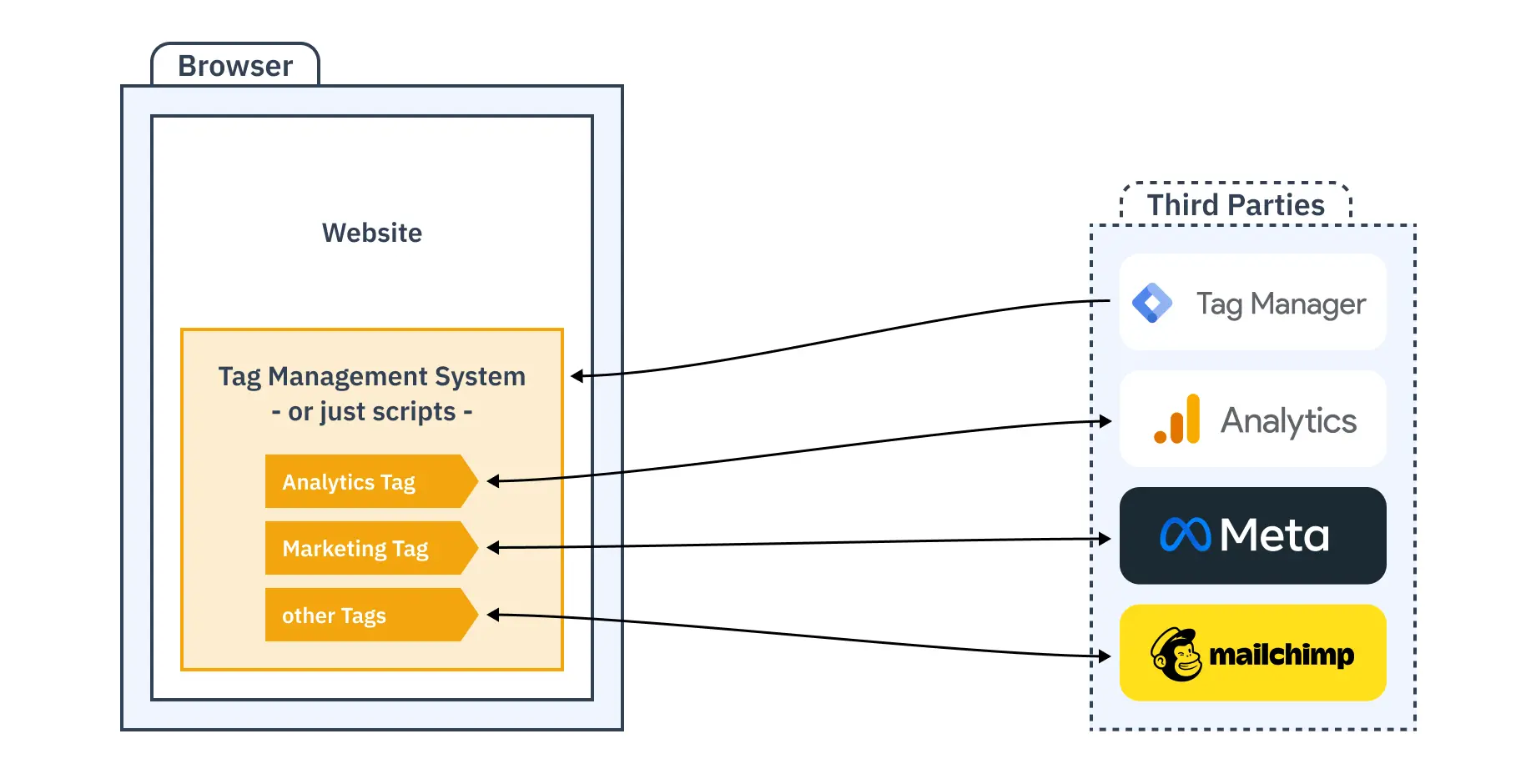
As soon as the browser opens a website, various JavaScript codes are executed. These so-called pixels or tags are responsible for data preparation and transmission. Depending on the number of these tags, a multitude of code is loaded and executed. The same applies to the resulting data streams, which are all similar but still different. The data ends up at Google Analytics, Meta, and every other integrated service.
So, the client handles the entire process. It collects the data, processes it, and transmits it to external servers.
What is server-side tracking?
In this approach, a server takes over the processing and transmission of data. Special software runs on the server, developed only for this purpose. For every service that is supposed to receive data, an integration is set up. As soon as relevant data for the service arrives at the server, the code is executed.
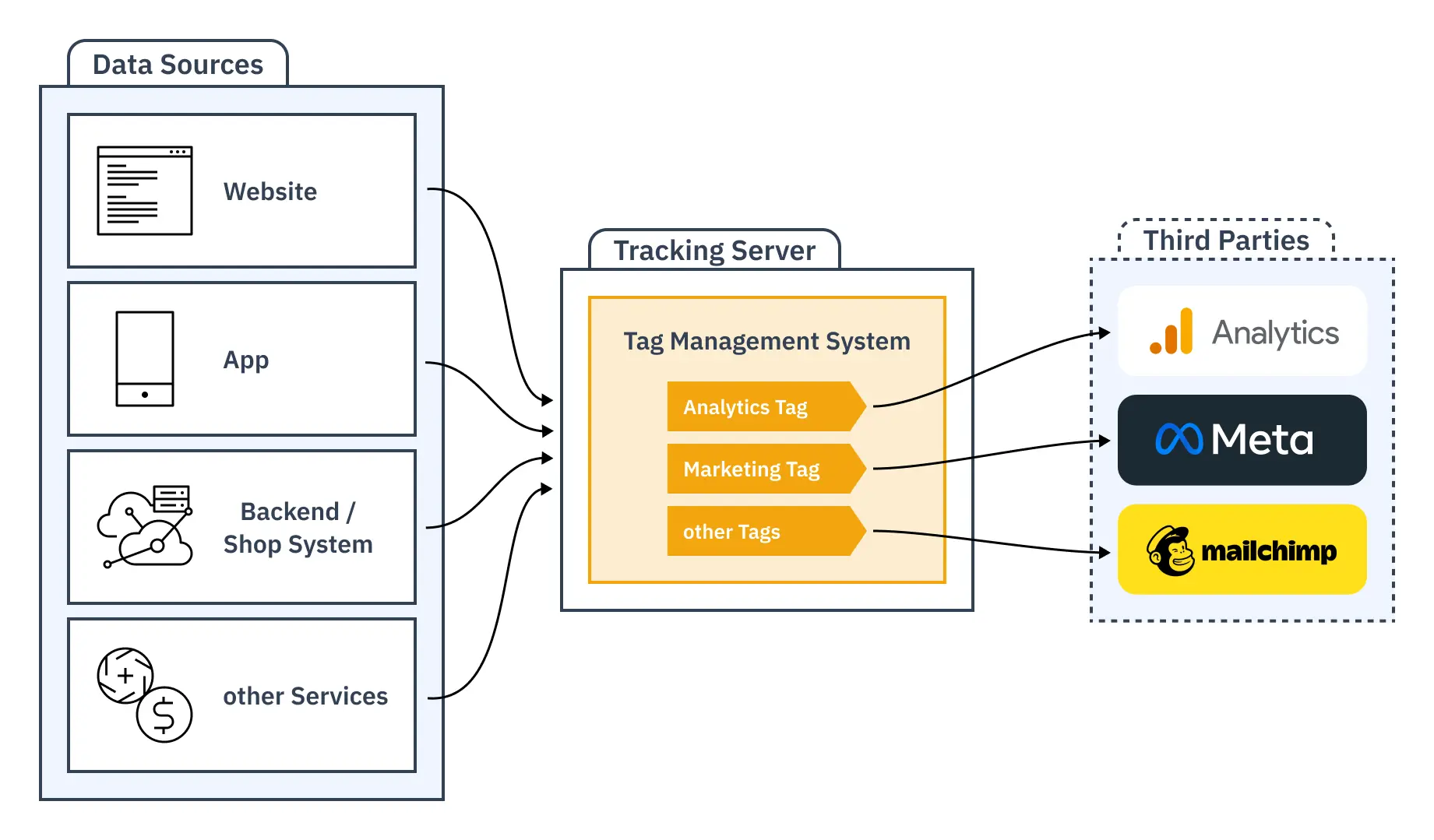
The data sources for the tracking server can be diverse. In addition to the client, this could be your own backend (e.g. shop system) or even external services (e.g. payment provider). Furthermore, there is often the possibility to enrich the incoming data. This can be done, for example, via a database query or an API.
Thus, various sources are responsible for the data generation. But the processing and transmission of the data takes place in one central place.
What advantages does server-side tracking offer?
Server-side tracking is no silver bullet either. The approach has various pros and cons that need to be considered before use.
Advantages of server-side tracking
- More data can be collected as tracking restrictions can be reduced
- Data can be enriched with (sensitive) information
- Full control over data flows
- Tracking is possible without cookies and personal data
- Potential improvement of data protection and security
- The loading time of your website is improved
Disadvantages of server-side tracking
- Certain events cannot be tracked (scrolling, displaying elements in viewport, ...)
- Increased complexity due to extra infrastructure and processes
- Potential lack of support for receiving data at the destination (tool, system, service)
- The service must be guaranteed 24/7, as server downtime means data loss
- Ongoing (minor) costs
Tip
Often the advantages of one approach are the disadvantages of the other. This also applies to the tracking methods. But you can benefit from this situation by pursuing a hybrid approach - using both client-side and server-side tracking methods simultaneously to achieve the best result.
The setup then becomes more complex, but also more flexible and powerful. Some tracking requirements can only be met in this way. This is especially true for events that can only be tracked in the client.
It's no wonder, then, that most of our customers choose this approach. Whether it's also the right approach for you, you can determine either alone or together with us. Schedule a call with us to find out how we can support you.
How does server-side tracking help with data protection?
Server-side tracking can lead to an improvement in data protection. Whether and exactly how depends on the specific implementation.
Control over data flows is the most important element. Modern JavaScript codes increasingly collect data autonomously, either as separate events or by enriching manually triggered events. Too, the recipients of the data gain access to the IP address. This happens automatically as part of the data exchange, resulting in the processing of personal data. All this can be avoided with a server-side implementation. Every event and every piece of data included can be manually defined. This way, you know exactly who gets what.
Another advantage can be achieved when using GTM tagging servers. The required Google scripts (e.g. from Google Tag Manager - gtm.js) can be served from your own tagging servers. This prevents Google from accessing the IP address, which should delight your data protection officer.
In general, third-party code on your website can also be seen as critical. Do you know what all those JavaScript codes do in detail? What data is automatically collected? What cookies are set? With a purely server-side implementation, you completely avoid this problem.
But, it must also be mentioned that server-side tracking can lead to new services. These must be evaluated and listed accordingly in the privacy policy. This can be seen as a disadvantage.
Information
As you may already know, we offer hosting for GTM tagging servers. As a German company, it was important to us that we host the servers in the EU too.
For all our European server locations, the following applies: 100% EU. This applies to both the physical location of the servers and their operators.
What needs to be considered during implementation?
It is safe to say that server-side tracking is ultimately just tracking. The software used is very similar to that used in client-side tracking. Tag Management Systems are also used here. They still have the familiar elements like tags, variables, and triggers.
The biggest difference lies in the data sources. Without these, your tracking server has nothing to do. Because unlike client-side tracking, the sources must be connected manually. Corresponding codes or entire SDKs are usually available for this. These need to be implemented in the relevant systems. Afterward, the data source must be configured in the tracking server.
The implementation of server-side tracking is based on six core elements:
- Architecture - should there be a complete switch to server-side tracking or only partially?
- Server - how and where will the servers run?
- Software - which one should I use?
- Data - what data do I need?
- Data sources - how can I connect my sources (website, app, shop, ...) to the tagging server? And how do I ensure that the relevant data is included?
- Configuration - who will handle the setup in the tag management system? Which services should receive data? Can they even receive data server-side?
This leads us to the most important question: What do I/we do ourselves? Everything is possible, from a "do-it-yourself" solution to complete outsourcing. The answer to this question is always very individual, as it depends on internal policies, existing expertise, time, and money.
All this also has an impact on the implementation speed. Anything from a few days to several weeks is possible.
Which systems and tools support server-side tracking?
We want to discuss the most important services that support server-side tracking. Because without support for receiving the data, no data can be transmitted server-side. Before implementation, it is necessary to verify this support.
Analytics
- Google Analytics
- Piwik PRO
- Matomo
- Adobe Analytics
- Heap (limited)
- Mixpanel
- Segment
Marketing
- Google Ads
- Meta (Facebook, Instagram, ...)
- TikTok
- Snap
- Klaviyo
- Hubspot
- Mailchimp
- SendGrid
- Taboola
- X (Twitter)
As you can see from the list, all relevant systems are supported. And more are being added weekly. This is because the advantages are simply so great.
Summary
For us, too, it is clear: server-side tracking is the future. It offers serveral advantages over conventional tracking. The gain in data quality and quantity alone pays off within a very short time, whether through faster A/B testing or improved advertising performance.
Data protection advantages can already be realized now and even more in the future. Tracking without cookies? Possible! Tracking without personal data? Also possible! Tracking based on first-party data? Yes!
This requires a rethinking of data sources, data collection itself. Yes, the tracking itself also needs to be adjusted, but it's worth it.
Careful planning and implementation are crucial for success. The goal is to find the best solution to realize the most relevant advantages while creating a solution that is as future-proof as possible.
If you need support with this, we are happy to assist you. Whether you are interested in our hosting solution for GTM tagging servers or our comprehensive expertise. We look forward to an exchange on this topic anytime. You can book a call with us at any time to discuss it.
Are you ready for server-side tracking?
We are happy to support you with your implementation, whether in person or through our hosting offer.